
Lincoln did more than utter eloquent addresses, or emancipate three million slaves, or make himself…
 freebeacon.com
 By Allen C. Guelzo
In his 1994 survey of Lincoln in American Memory, Merrill D. Peterson identified five themes which have summed-up the meaning of Abraham Lincoln for Americans since Lincoln’s death in 1865. Those five themes hold little surprise—Lincoln as Savior of the Union, Lincoln as the Great Emancipator, Lincoln as the Man of the People, Lincoln as the First American, and Lincoln as the Self-Made Man—and they are mirrored perfectly by the Lincoln who sits in the majestic chair of state in his Memorial (which, by the way, appears on the dustjacket of Peterson’s book).
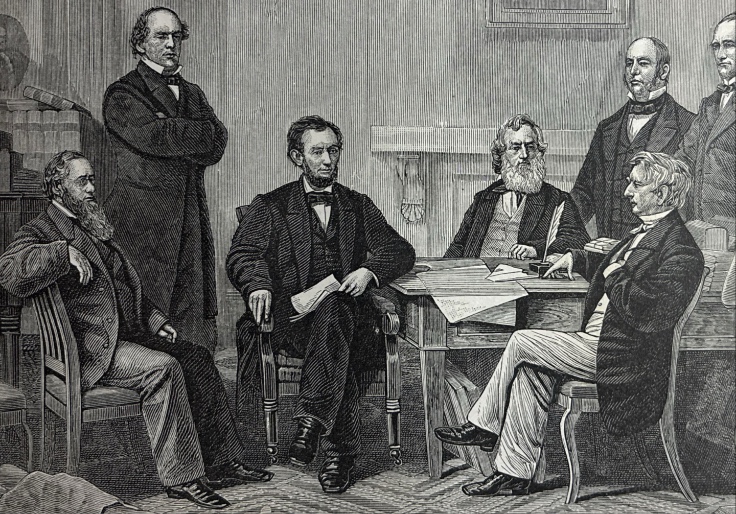
What was missing from Peterson’s enumeration was one theme that should have been obvious, and that was Lincoln the Politician. After all, Lincoln did more than utter eloquent addresses, or emancipate three million slaves, or make himself something out of nothing. He navigated the turbulent waters of a democracy that was being ripped apart by civil war, brought that war to a successful conclusion, and cajoled friends and enemies alike into following his direction. “The Tycoon,” as his secretary John Hay called him in the summer of 1863, “is managing this war, … foreign relations, and planning a reconstruction of the Union, all at once. I never knew with what tyrannous authority he rules the Cabinet, till now. The most important things he decides and there is no cavil.”
Of course, we prefer to remember Lincoln the Statesman rather than Lincoln the Politician. Statecraft embodies nobility of purpose, shrewdness of insight, and prudential management of public affairs. But we are not doing sufficient justice to either Lincoln or ourselves if we forget how very much Lincoln was a career politician, in the fullest sense of the word. “Politics were his life,” insisted his longtime law partner, William Henry Herndon, “and his great ambition his motive power.” His confidence in his own judgment sometimes reached the borders of arrogance, and when John Hay tried to show him articles in the journals of the day “on some special subject,” Lincoln dismissed him out of hand: “I know more about it that any of them.”
It also does no justice to either Lincoln or ourselves to ignore the Politician, if only because in a democracy, politics is precisely what makes the world go round…
READ FULL ARTICLE HERE… (freebeacon.com)


Home | Caravan to Midnight




Be First to Comment